
 CH
CH
 INQUIRY

Products
How to Stably Complete Three CNC Machining Operations on Convex Aluminum Parts
Machining convex aluminum parts may seem simple in CAD — but in real production, achieving stable, high-quality, and repeatable results remains a major challenge. This article demonstrates a practical and efficient three-step CNC milling strategy — performing roughing, contour milling, and drilling in one stable setup using the SZGH-650 CNC milling machine. It focuses on real manufacturing decisions that improve surface quality, dimensional accuracy, and production efficiency.
Classification:
Product Description
How to Stably Complete Three CNC Machining Operations on Convex Aluminum Parts
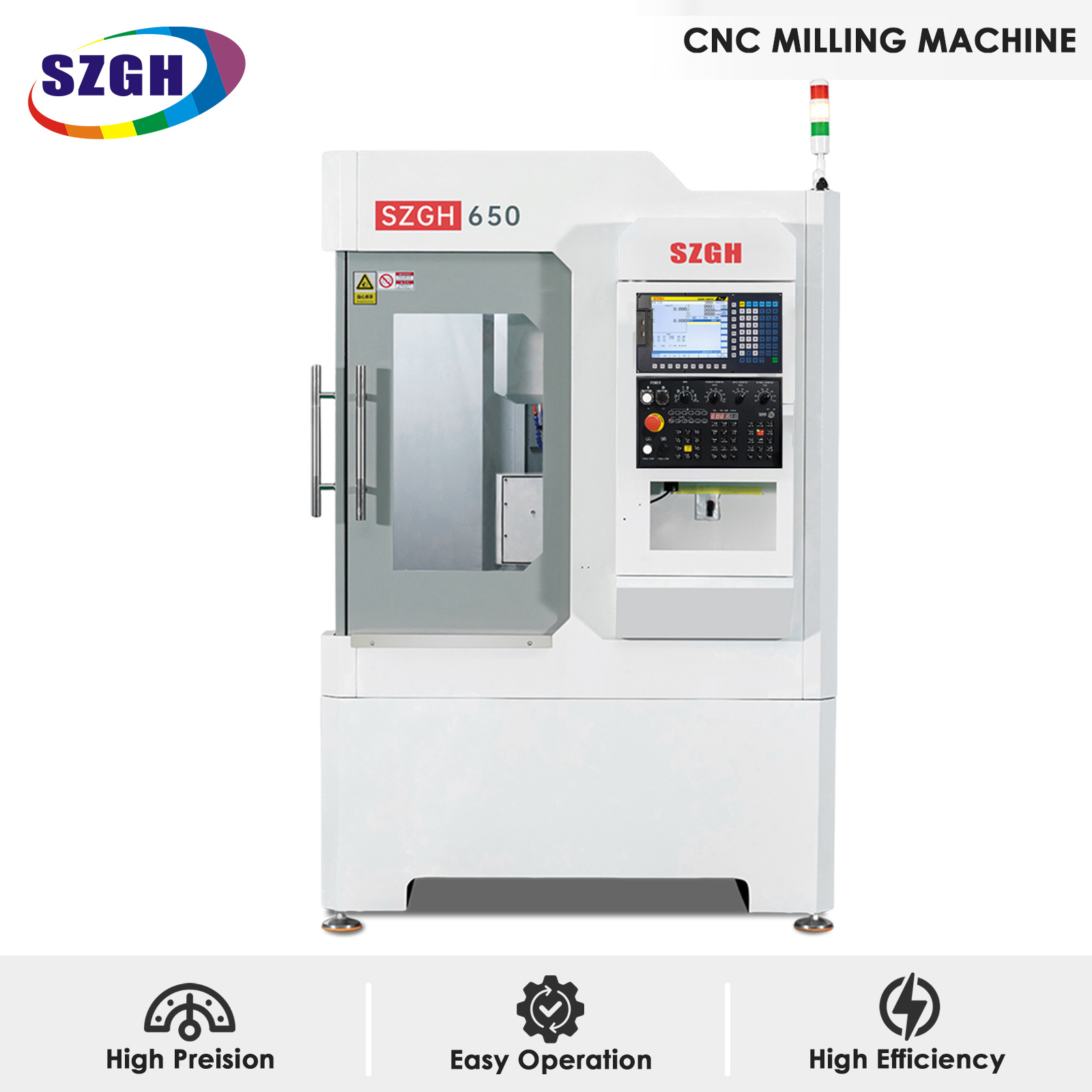
Application Example: SZGH-650 CNC Milling Machine
Machining convex aluminum parts may seem simple in CAD — but in real production, achieving stable, high-quality, and repeatable results remains a major challenge.
This article demonstrates a practical and efficient three-step CNC milling strategy — performing roughing, contour milling, and drilling in one stable setup using the SZGH-650 CNC milling machine. It focuses on real manufacturing decisions that improve surface quality, dimensional accuracy, and production efficiency.
Why This CNC Machining Process Matters
In aluminum cnc machining, especially for convex parts with continuous curves and features:
1.Tool engagement constantly changes
2.Chip evacuation becomes difficult at high speeds
3.Vibration easily creates visible marks
4.Re-clamping between operations leads to positional errors
For manufacturers producing aluminum brackets, housings, and structural parts, these issues directly affect quality, scrap rate, throughput, and customer satisfaction.
This complete process ensures all three operations are finished in one setup, minimizing error accumulation, reducing cycle time, and improving consistency.
Step 1 — Stable Face Roughing: Foundation of CNC Milling
Efficiently removing stock while maintaining stability is the cornerstone of any aluminum cnc machining process.
Recommended Roughing Strategy:
Use constant engagement or adaptive roughing to maintain steady tool loads
Avoid sudden tool engagement changes on convex surfaces
Leave uniform stock allowance for finishing
What to Watch:
1.Chip Evacuation: Aluminum chips tend to stick — air blast or coolant helps
2.Spindle Load Stability: Fluctuations indicate vibration or recutting
3.Sound & Finish: Audible chatter usually predicts finishing defects
Target Result:
A stable, stress-free rough surface with consistent remaining material — ready for smooth contour milling.
Step 2 — Precision Contour Milling: Smooth Convex Surface Finish
Surface quality is defined during contour milling. Convex aluminum CNC milling requires:
Controlled step-over
Consistent scallop height
Smooth lead-in and lead-out paths
Why Rigidity Matters:
Even minor vibration on convex profiles can leave visible transition marks. A rigid spindle, responsive servo system, and precision guideways enable smooth interpolation and high-quality finishes.
Desired Outcome:
1.Natural surface transitions
2. No visible tool marks
3. Surface finish suitable for assembly or light post-processing
Step 3 — Accurate Drilling: Consistent Hole Positioning
Drilling may seem simple, but hole positioning directly impacts assembly accuracy. In this workflow:
1. Drilling is completed in the same setup as milling
2. Spot drilling prevents tool walking
3.Peck drilling improves chip removal in deeper features
Quality Checkpoints:
1.Hole-to-hole consistency across batches
2.Clean hole edges with minimal burrs
3.Repeatable results after tool changes
4.Real CNC Milling Performance — SZGH-650 Example
The SZGH-650 cnc milling machine demonstrates this process with excellent stability and efficiency.
Machine Advantages for Aluminum CNC Machining
1.Powerful Spindle: 5.5 kW servo motor, up to 6000 RPM, BT40 interface for rigidity
2.Smooth Motion Control: Taiwan Precision ball screws + C3 guideways support accurate contouring
3.Responsive Control: SZGH-1080MIC CNC controller with absolute axis servo motors & EtherCat drivers
4.Multi-Tool Capability: 10-station tool magazine supports roughing, contouring, and drilling without re-clamping
5.Travel Matching: 500 × 600 × 300 mm axis travel — ideal for small-to-medium aluminum parts
Operational Highlights:
1. Stable roughing with continuous cutting action
2. Natural contour transition with excellent surface follow-up
3. Repeatable drilling with consistent hole distribution
4. Reduced auxiliary time and changeovers
This integration of configuration and actual machining performance makes SZGH-650 a practical solution for comprehensive aluminum cnc machining online.
Who Benefits Most from This CNC Machining Strategy?
This approach is ideal for:
1.Manufacturers & Job Shops — Want consistent part quality and reduced scrap
2.Engineers — Seeking stable machining dynamics & reliable surface finish
3.Procurement Teams — Looking for machinery with strong ROI, stability, and throughput
4.Production Managers — Needing efficient workflows, minimal setups, and higher uptime End Users — Expect parts 5.ready for assembly with minimal post-processing
Frequently Asked Questions
Q: What aluminum grades work best?
A: 6061 and 7075 aluminum alloys are commonly processed with this workflow, with parameter adjustments based on material hardness.
Q: How do you reduce chatter in convex aluminum milling?
A: Stable tool engagement, proper workholding, rigid spindle interfaces, and smooth toolpaths are key.
Q: Why complete all operations in one setup?
A: One setup minimizes cumulative positioning errors and improves repeatability across batches.
Q: What causes tool marks during contour milling?
A: Inconsistent feed rates, vibration, and poor lead-in/out strategies are common causes.
Q: Is this process suitable for high-volume production?
A: Yes — especially where repeatability and cycle-time efficiency are important.
Final Thoughts — CNC Machining That Drives Results
Convex aluminum parts demand more than high spindle speed; they require a well-balanced combination of rigidity, control, and smart process planning.
By completing roughing, contour milling, and drilling in one stable setup — and by choosing a machine like the SZGH-650 cnc milling machine — manufacturers can achieve:
- Better surface quality
- Tighter tolerances
- More predictable production performance
- Lower rework and fewer rejects
Contact Us to Improve Your Aluminum Machining
If your product requires machining of flat, contoured, or curved aluminum surfaces:
Send us your workpiece drawings and requirements.
We’ll help you evaluate suitable cnc milling machine models and configurations based on your specific application — improving your manufacturing efficiency and stability.
Previous Page
Previous Page

Follow us


Fax:+86-755-61885186


what app&We chat ID: +86-18098966732

Address: Floor 3, Building 5, Southern Digital Innovation Industry Base, No.80 Puxia Road, Henggang Liuyu Community, Longgang District, Shenzhen

SAF Coolest v1.3.1.2 设置面板 GQWSD-ZIXF-XAAEE-AZS
无数据提示
Sorry, the current column is being updated, please look forward to it!
You can view other columns or returnHome Page