
 CH
CH
 INQUIRY

Products
CNC Turning Aluminum Chess Pieces on SZGH-36J CNC Lathe| Application Case
Why Use One Tool for Aluminum Chess Piece Turning? Using a single tool throughout the machining process offers several practical advantages: Reduced tool change time Lower tooling cost Consistent tool reference position Improved surface continuity Simplified CNC programming
Classification:
Product Description
CNC Turning Aluminum Chess Pieces on SZGH-36J CNC Lathe| Application Case
Application Background of Aluminum Chess Piece CNC Turning
Aluminum chess pieces are typical small turned components used in decorative products, premium chess sets, and customized metal crafts.
Although the part size is relatively small, end users usually require:
- Smooth surface finish
- Consistent outer diameter profile
- Stable batch-to-batch accuracy
- Efficient production with minimal tooling complexity
This application case demonstrates how an aluminum chess piece is machined on the SZGH-36J CNC lathe, using only one cutting tool to complete the entire turning process, including rough machining, finish machining, and parting-off.
Rather than focusing on theoretical machining methods, this case is based on a real production process, showing how stable machining is achieved under practical shop-floor conditions.
Workpiece & Material Information
- Workpiece: Aluminum chess piece
- Material: Aluminum alloy
- Machining type: CNC turning
- Main operations:
Outer diameter turning
Profile turning
Parting-off
- Tooling: Single turning tool
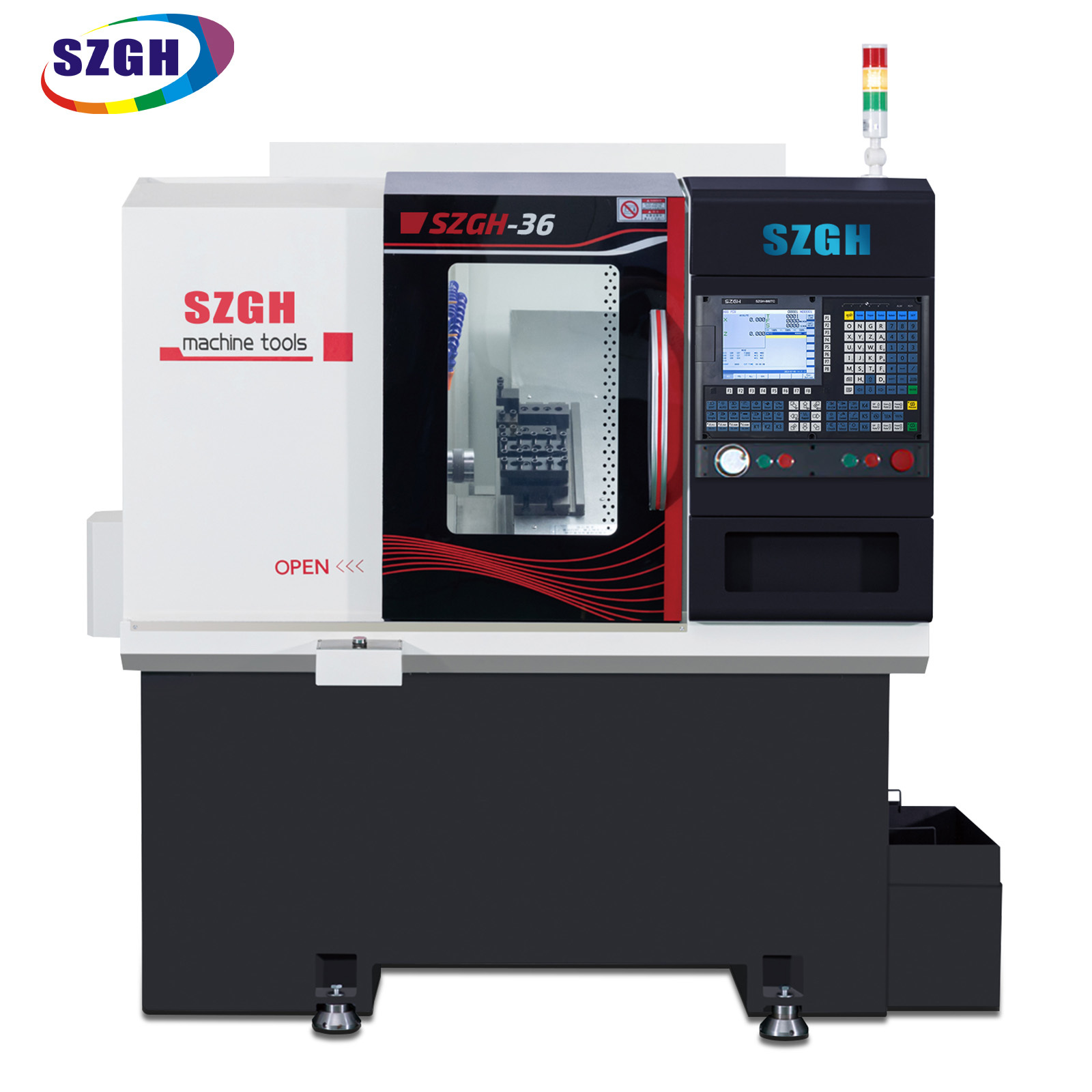
- Machine: SZGH-36J CNC Lathe
The workpiece features multiple diameter sections and smooth contour transitions, which places higher demands on feed stability and surface continuity during turning.
Machining Challenges in Aluminum Chess Piece Turning
From an engineering perspective, this part presents several typical challenges in aluminum turning:
1.Multiple profile segments
The chess piece includes stepped and curved outer diameters, requiring frequent feed changes and precise path control.
2.Surface finish requirements
As a decorative component, even minor tool marks or feed inconsistencies are visually unacceptable.
3.Single-tool machining strategy
Using only one tool reduces setup complexity but increases the need for long, continuous cutting stability.
4.Parting-off stability
For small aluminum parts, parting-off is often the most vibration-sensitive operation.
To ensure stable results, the machining process and machine capabilities must work together as a complete system.
CNC Turning Process on SZGH-36J CNC Lathe
Step 1: Segmented Rough Turning
The process begins with segmented rough turning along the outer diameter.
- Material is removed in controlled sections
- Cutting depth is managed to maintain stable cutting forces
- Aluminum chips are evacuated smoothly
From an engineering standpoint, segmented roughing helps prevent sudden load changes and reduces the risk of vibration during initial material removal.
Stable spindle performance and consistent feed response are essential at this stage to ensure a uniform rough profile for subsequent finishing.
Step 2: Segmented Finish Turning
After rough turning, the same tool is used for segmented finish turning.
- Each profile section is finished individually
- Feed rate transitions are carefully controlled
- Surface roughness is significantly improved
This step places higher demands on feed smoothness and axis response, as frequent acceleration and deceleration occur between profile segments.
Smooth interpolation and stable servo control help prevent visible tool marks and surface discontinuities.
Step 3: Overall Finish Turning
Once all segments are finished, an overall finishing pass is applied across the entire contour.
- The tool follows the complete outer profile in one continuous path
- Minor step marks between segments are eliminated
- Dimensional consistency is further refined
For decorative aluminum parts, this overall finishing step is critical in achieving a visually uniform surface.
Long, continuous tool paths require reliable motion control and stable machine rigidity to maintain accuracy from start to end.
Step 4: Parting-Off Operation
Finally, the workpiece is separated using the same tool.
- Stable parting-off without chatter
- Clean cutting surface
- High repeatability for continuous production
Parting-off is often the most sensitive operation in small-part turning.
Machine rigidity and spindle stability play a key role in preventing vibration and ensuring a clean cut.
Why Use One Tool for Aluminum Chess Piece Turning?
Using a single tool throughout the machining process offers several practical advantages:
Reduced tool change time
Lower tooling cost
Consistent tool reference position
Improved surface continuity
Simplified CNC programming
However, this strategy also requires the CNC lathe to maintain stable performance over long, uninterrupted cutting paths.
In this application, the combination of controlled cutting parameters and reliable machine behavior allows the single-tool approach to be used effectively.
Performance of SZGH-36J CNC Lathe in This Application
In this aluminum chess piece application, the SZGH-36J CNC lathe demonstrates:
Stable cutting performance in aluminum
Smooth spindle operation at high speed
Reliable control of fine turning paths
Excellent repeatability for batch production
The machine is well-suited for small to medium-sized aluminum turning applications, especially where surface quality and efficiency are required.
Typical Applications for Similar Aluminum Turned Parts
This machining method and machine setup can also be applied to:
Decorative aluminum parts
Metal chess pieces
Small turned aluminum components
Custom consumer products
Gift and craft metal parts
Conclusion: Stable CNC Turning Solution for Aluminum Parts
This application case demonstrates how an aluminum chess piece can be efficiently machined on the SZGH-36J CNC lathe using a single cutting tool, from segmented rough turning to final finishing and parting-off.
By focusing on the actual machining process and engineering considerations, this solution helps end users achieve:
- Stable machining performance
- Reduced tooling complexity
- Consistent surface finish
- Reliable batch production
For manufacturers producing similar aluminum turned parts, this application provides a practical and repeatable CNC turning reference.
Interested in machining similar aluminum parts?
Contact us to learn more about the SZGH-36J CNC lathe and its real-world turning applications.
Previous Page
Previous Page

Follow us


Fax:+86-755-61885186


what app&We chat ID: +86-18098966732

Address: Floor 2, Building 5, Southern Digital Innovation Industry Base, No.80 Puxia Road, Henggang Liuyu Community, Longgang District, Shenzhen

SAF Coolest v1.3.1.2 设置面板 GQWSD-ZIXF-XAAEE-AZS
无数据提示
Sorry, the current column is being updated, please look forward to it!
You can view other columns or returnHome Page